Educational Overview
The Equine Nervous System
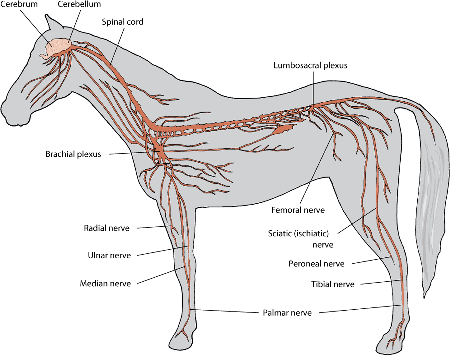
The equine nervous system is the body’s primary communication and coordination network, guiding movement, balance, sensation, behaviour, and internal regulation.
It allows the horse to respond to its environment, maintain posture, and support overall wellbeing.
Key components
-
Central Nervous System (CNS):
Comprises the brain and spinal cord, responsible for processing information, coordinating voluntary movement, and integrating sensory input.
-
Peripheral Nervous System (PNS):
A network of nerves extending throughout the body, transmitting signals between the CNS and muscles, skin, and organs.
-
Autonomic Nervous System:
Regulates involuntary functions such as heart rate, digestion, respiration, and stress responses, helping maintain internal balance.
Functions and awareness
Through this system, horses maintain coordination, reflexes, muscle tone, and responsiveness.
Changes in nervous system balance may be reflected in altered movement, posture, sensitivity, behaviour, or responsiveness.
Because horses are highly perceptive animals, the nervous system also plays a role in alertness, learning, and interaction with their surroundings.
Environmental and management influences
Factors such as nutrition, workload, environment, stress, and injury can influence nervous system function.
Observing a horse’s movement, demeanour, and responses can provide useful insight into overall neurological wellbeing.
Educational summary
The equine nervous system supports communication between the brain, body, and environment, enabling movement, coordination, and internal regulation.
Awareness of normal behaviour and function helps identify when professional veterinary assessment may be appropriate.
This information is provided for educational purposes only and does not replace veterinary advice or diagnosis.
SET OF
Educational Purposes
Equine – Nervous Behaviour Herbs
Gentle Natural Calm for Horses
-
Traditional Calm — Certain herbs have long been valued for their association with easing restlessness and promoting a sense of calm.
-
Balance & Steadiness — Traditionally linked with grounding and inner balance, natural supports may encourage steadiness in horses during times of heightened energy.
-
For Everyday Situations — Travel, competition, changes in environment, or training can sometimes make horses unsettled. Herbal supports can serve as gentle companions through these transitions.
-
Holistic Harmony — Works best as part of a whole-care approach that includes steady routines, calm handling, and mindful management.
-
Natural Choice — Plant-based and traditionally connected with emotional balance and wellbeing.
The Role of Magnesium for Nervous & Performance Animals
Magnesium is one of the body’s key minerals, traditionally associated with:
-
Muscle Relaxation — helping maintain ease and balance under physical strain.
-
Nervous System Calm — symbolically linked with steadiness and reducing restlessness.
-
Performance Balance — valued for supporting animals in training, competition, or under stress.
Options for Supplementation
-
Magnesium Lick — a simple and natural way for animals to self-select mineral support.
-
Magnesium Glycinate Powder — easily mixed with meals, traditionally linked with gentle absorption.
-
Magnesium Ion Liquid — a convenient liquid form, traditionally valued for its rapid uptake.
-
ReMag Liquid Samples — available for trial use to see how your animal responds.
* Natural pet botanicals are not intended to replace veterinary care or medication. Our formulas are offered as an alternative health support for your animal's condition and not as a cure.
Formulated with plant-based ingredients selected for their gentle role in supporting overall balance and wellbeing.
SET OF 1
Equine Nervo-150 Mix
Contains:
A = Combo herbs B to G together
Or Choose single ones
B = single herb Valerian
C = single herb Vervain
D = single herb Chamomile
E = single herb Hops
F = single herb Passion flower
G = single herb St Johns Wort
B = Valerian (Valeriana officinalis)
Reference: https://www.healthline.com/nutrition/valerian-root
C = Vervain (Verbena officinalis)
Reference: https://draxe.com/nutrition/vervain/
D = Chamomile (Matricaria recutita)
Reference: https://www.cochranelibrary.com/central/doi/10.1002/central/CN-01248214/full
E = Hops (Humulus lupus)
Reference: http://cms.herbalgram.org/expandedE/Hops.html
F = PassionFlower (Passiflora incarnata)
Reference: https://www.webmd.com/vitamins/ai/ingredientmono-871/passionflower
OR
G = St Johns Wort (Hypericum)
Reference: https://www.ncbi.nlm.nih.gov/books/NBK92750/
Gentle Natural Balance for Different Types of Horses
Every horse expresses nervous energy differently. These formulas draw on traditional herbal associations to support balance, calm, and focus.
-
Type B (Valerian) — Traditionally linked with calming tense muscles and easing rigid patterns of fear. (Note: Valerian is swab-positive for racing horses and therefore excluded from racehorse formulas.)
-
Type C (Vervain) — Associated with sensitive skin and high reactivity, traditionally valued for soothing agitation in horses that are restless and twitchy
.
-
Type D (Chamomile) — Known for its connection with digestive comfort, chamomile has long been used in traditional practice for nervous horses that “worry in the gut” and lose condition under stress.
-
Type E (Hops) — Symbolically tied to calming a busy mind, this support is linked with focus and steadiness for horses that are easily distracted.
-
Type F (Passionflower) — Traditionally seen as helping to “reset patterns,” passionflower has been valued for encouraging relaxation and balance, especially when paired with mindful handling.
-
Type G (Hypericum) — In traditional herbalism, Hypericum has been linked with nervous system balance and renewal, especially where old stress patterns linger.
Dosage for a horse is minimum dosing due to their unique metabolism.
For example approx. 10 drops as "one dose" is all that needed for horse, due to their unique metabolism.
Need more advice or have more questions? Contact us for a FREE consultation with one of our fully qualified practitioners.
These statements are for general wellbeing and educational purposes only. This product is not intended to diagnose, treat, or prevent any disease. Always seek veterinary or professional advice for specific health concerns.
DISCLAIMER
The statements made regarding these products have not been evaluated by the Food and Drug Administration. The efficacy of these products has not been confirmed by FDA-approved research. These products are not intended to diagnose, treat, cure or prevent any disease. All information presented here is not meant as a substitute for or alternative to information from your health care practitioners. The Federal Food, Drug, and Cosmetic Act require this notice.